
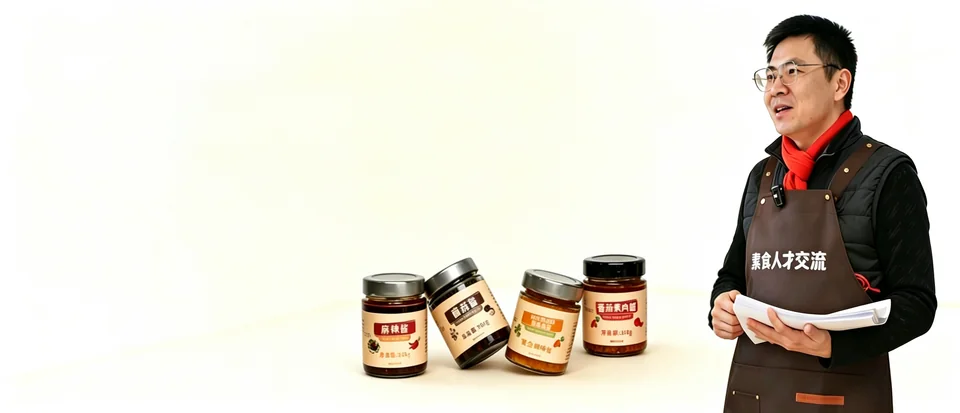
A private-label project does not always begin with a large brand or a finished formula. Sometimes it begins with a person who has spent years asking a simple question: what is worth eating every day?
YuanTi Talks Vegetarian is a vegetarian creator with 15 years of experience living with vegetarian food. Together with Seleglu, the creator set out to develop four sauces that felt honest to the way people actually eat at home: useful, flavourful and made with a product story they could stand behind.
The goal was not to make a polished internet-famous sauce first and work out the details later. The teams chose the slower route: start with the eating experience, test the difficult parts and keep returning to the question of whether they would be happy to serve the sauce to their own families.
Four sauces, four different challenges
The project brought together four of Seleglu’s current sauces and condiments:
- Plant-Based Egg Yolk-Style Sauce — the most technically demanding of the four. The team worked for around three months, repeatedly adjusting the formula and the high-temperature sterilisation process to create a savoury, sandy and rich texture without using egg. There were moments when the project nearly stopped, but the team kept working through the difficult details.
- Plant-Based Bolognese-Style Sauce — a familiar, everyday direction built around fresh tomato, natural acidity and sweetness, and plant-based pieces that hold their texture.
- Mushroom Sauce — a natural savoury direction developed through repeated testing of mixed-mushroom ratios and carefully selected seasonings.
- Mala Sauce — a layered Sichuan-style flavour in which the pepper and chilli are designed to build through the bite, rather than delivering heat without depth.
The four sauces were designed for ordinary meals: mixing with rice or noodles, adding to a stir-fry, or using as a dipping sauce. That everyday usefulness was part of the collaboration’s point. A product can be technically well made and still need to earn its place in a real kitchen.
Why start with 500 bottles?
The creator’s project began with 500 bottles per product category. For a new brand, that number became a practical starting point: enough product to test a market, but small enough to take the first step without turning the first decision into an irreversible commitment.
A small order did not mean a small amount of care. Seleglu’s support covered the parts that can otherwise feel difficult for a new brand:
- Product selection: helping turn an idea into a workable product direction.
- Ingredient support: reviewing ingredient sources and the product story behind them.
- Production support: arranging small-batch production and maintaining quality controls for the project.
- Packaging support: discussing packaging options suitable for a new brand and a smaller first run.
The model is intentionally collaborative. If customer feedback suggests a change, the next batch can become a new learning cycle. If the product finds its audience, the brand can discuss additional production. The first 500 bottles are not meant to define the whole future; they are a way to begin with room to learn.
A private-label project with a human starting point
For Seleglu, this project shows why private label is not only a manufacturing service. It can be a bridge between a creator’s lived experience, a product team’s technical patience and a customer’s wish to put something meaningful on the shelf.
Seleglu welcomes conversations from brand owners, creators and food businesses with a product idea, an existing formula or a need to review current sauces for private label. Product availability, packaging, quantities, target-market requirements and commercial conditions are confirmed case by case.
You do not need to start as a large brand. You need a clear idea, a reason to make it and the willingness to begin with a first practical batch.